Introduction
Ask ten people whether addiction is a disease, a habit, or a choice, and you’ll probably get ten different answers — some insisting it’s a disease, others arguing it’s a series of choices, still others calling it a powerful habit that’s grown out of control. Part of why the debate never really settles is that each view captures something true. The mistake is assuming the answer has to be only one of them. Addiction involves biology, learning, habit, emotion, decision-making, and environment all at once — which is a lot more complicated than any single label can hold.
The Disease Lens
Many medical organizations describe addiction as a disease or disorder, partly because researchers have observed measurable changes in brain systems tied to reward, motivation, learning, and decision-making. Repeated use can alter how these systems function, influencing cravings, impulse control, and the ability to stop despite consequences. From this angle, addiction isn’t simply weak character — it’s a condition that affects the brain and behavior together. One real advantage of this model is that it tends to push treatment toward compassion instead of shame and punishment.
The Habit Lens
This view emphasizes repetition: every time a behavior repeats, the brain gets more efficient at performing it. Trigger, craving, behavior, relief, repeat — the more often the cycle runs, the stronger it becomes, sharing a lot of the same mechanics as other habits, just usually far more powerful and harder to break. This lens highlights the importance of practice, environment, and routine in actually changing the pattern.
The Choice Lens — and Why It Gets Misread
The choice lens tends to get the strongest reactions, often because people hear “choice” and assume it means stopping should be easy. It doesn’t follow that way at all — exercise, healthy eating, and forgiveness all involve choice too, and none of them are simple. Addiction can absolutely affect a person’s ability to make certain choices consistently, while choice still remains part of the picture. People don’t control every urge or craving, but they typically retain some ability to influence their actions — and recovery usually grows through a series of those choices, repeated over time.
Why the Debate Gets Stuck
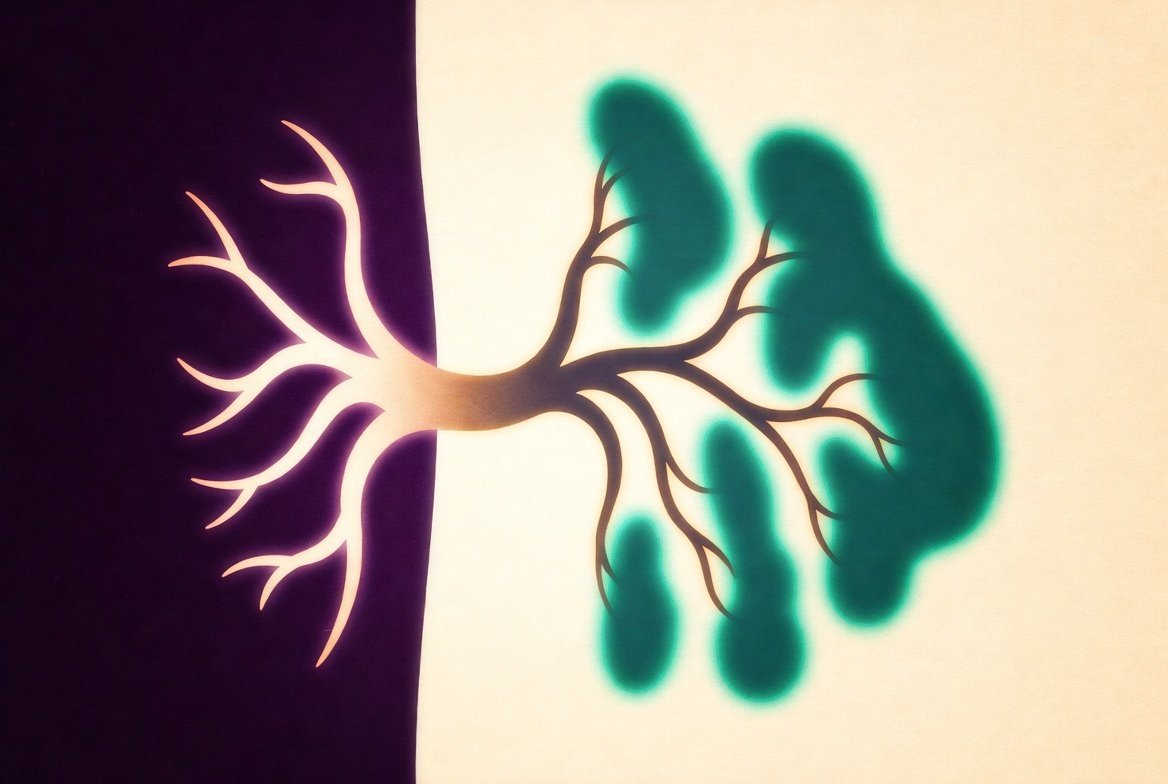
Picture three people describing a tree — one focused on the roots, one on the trunk, one on the branches. They look like they’re disagreeing, but they’re really just describing different parts of the same organism. The disease lens leans on biology, the habit lens on learning, the choice lens on behavior and responsibility. Each highlights something real. None tells the whole story alone.
For most people, addiction actually begins with a choice — taking a drink, trying a substance, opening an app. As repetition builds, the experience changes: more automatic, more reinforced, more tangled up with emotion and coping. The role choice plays gets more complicated as it goes, which helps explain why stopping often feels so much harder than starting ever did.
Why Responsibility Still Matters — and Why Shame Doesn’t Help
A common worry about the disease model is that it removes accountability. In practice, effective recovery requires responsibility no matter which model you use. You may not have chosen your genetics, your upbringing, or your trauma — but you still play a critical role in your own recovery. Understanding a problem doesn’t remove responsibility for addressing it.
The opposite mistake is assuming that because choice is involved, shame must be useful. It usually isn’t — shame tends to produce hiding, isolation, and hopelessness, none of which support lasting change. Accountability helps. Understanding helps. Shame mostly just gets in the way.
A More Useful Question
Instead of arguing disease versus habit versus choice, a more useful question is simply: what actually helps people get better? Regardless of which model someone prefers, real recovery tends to involve the same ingredients — awareness, honesty, support, new habits, better coping skills, and consistent effort. The path forward usually looks remarkably similar no matter which lens you started from.
Addiction probably isn’t fully captured by any single word. It’s not only a disease, only a habit, or only a choice — it’s a human struggle shaped by interacting forces, and understanding those forces can create compassion while taking responsibility still creates the actual change. The goal was never winning the debate. It’s recovery.